
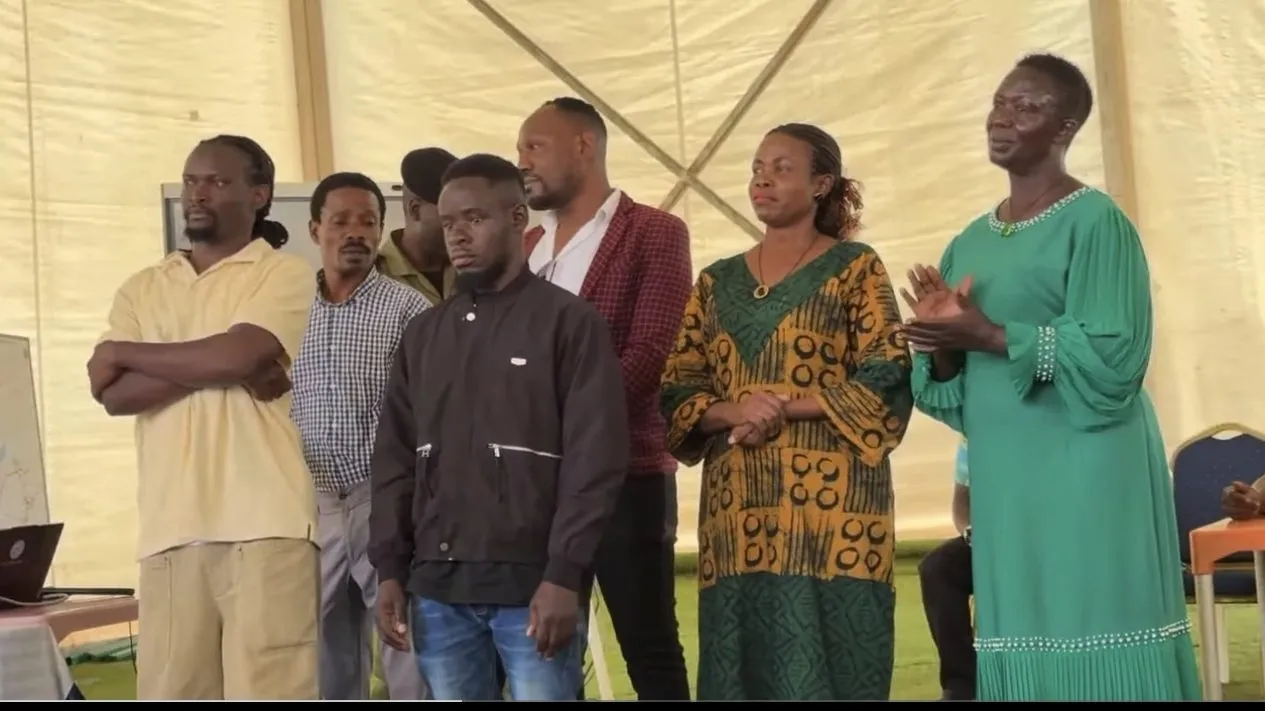
A long-standing dispute over the biological children of legendary Ugandan Kadongo Kamu musician Paul Kafeero has finally been settled after DNA tests established that only four of the 25 individuals who claimed to be his children are biologically related to him.
The findings were officially announced on Thursday at the Uganda Police Headquarters in Naguru by experts from the Government Analytical Laboratory together with the Uganda Police Forensic Services Laboratory.
The DNA exercise was conducted under a court order that permitted the exhumation of Kafeero’s remains. Forensic specialists collected samples from the late musician’s body and compared them with DNA samples submitted by people who had claimed to be his biological children.
The analysis confirmed that Thomas Kafeero Schwarzenegger, Simon Peter Kafeero, Benedicto Kafeero, and Elizabeth Nagawa are the only biological children of the late singer.
The other 21 individuals who participated in the DNA verification process were found not to share a biological relationship with Kafeero.
Among those who submitted samples were Thomas Kafeero, Simon Peter Kafeero, John Kafeero, Benedicto Kafeero, Aroon Nagawa, Elizabeth Nagawa, Phillip, Tonny, John Mark, Meddi, Godfrey Muwanguzi, Ssendi Shafik, Katumba Eric, John Martin Kafeero, Paul Ssentongo, Kate Nalukwago, Margaret Nakafeero, Grace Nalukwago, Leticia Nalukwago, Rehema Namulindwa, Tana Birungio, Joan Mirembe, Noelena Ssali, Mukiibi Kafeero, among others.
The event was attended by the Minister of Local Government, Balaam Barugahara, who was instrumental in initiating the DNA verification process during his tenure as Minister of Gender, Labour and Social Development.
There were emotional scenes as the results were announced. Several individuals whose claims were disproved were overcome with emotion, with some breaking down in tears. Meanwhile, the four confirmed children welcomed the outcome with relief, describing it as the end of years of uncertainty.
Speaking on behalf of the family, Kafeero’s brother, Vincent Mende, thanked Minister Barugahara for his efforts in helping resolve an issue that had remained unresolved for many years.
Mende said the prolonged uncertainty had affected the family’s unity and peace, emphasizing that the DNA exercise was intended to establish the truth and strengthen family ties rather than fuel conflicts over the late musician’s property.
Family friend James Ssenkubuge also appealed to those disappointed by the findings to remain calm. He said the exercise was carried out to protect Kafeero’s legacy and encouraged families to address paternity questions while parents are still alive to prevent similar disputes in the future.
Barugahara expressed appreciation to the Uganda Police and the Government Analytical Laboratory for successfully carrying out the court-directed exercise. He also pledged continued support to the four confirmed children while noting that government development programs remain accessible to other citizens.
The minister further encouraged parents to make use of modern DNA testing services during their lifetime whenever questions of paternity arise, saying such measures can help avoid future family disagreements.
Officials from the Uganda Police Forensic Services Laboratory explained that the DNA analysis followed all court-approved procedures. Samples were collected from various parts of Kafeero’s remains, including the femur, jawbone, skull, and hair, before forensic experts generated the DNA profile used for comparison.
Authorities also confirmed that Kafeero’s DNA profile will remain securely stored, allowing any future claimant to undergo verification if necessary.
Following the announcement, Barugahara urged the four confirmed biological children to take responsibility for protecting, managing, and preserving their late father’s estate.
Paul Kafeero, who died in 2007, is remembered as one of Uganda’s greatest Kadongo Kamu musicians. Nearly two decades after his passing, questions surrounding his biological children continued to generate public debate and legal disputes until the court-authorized DNA exercise finally provided definitive answers.

