


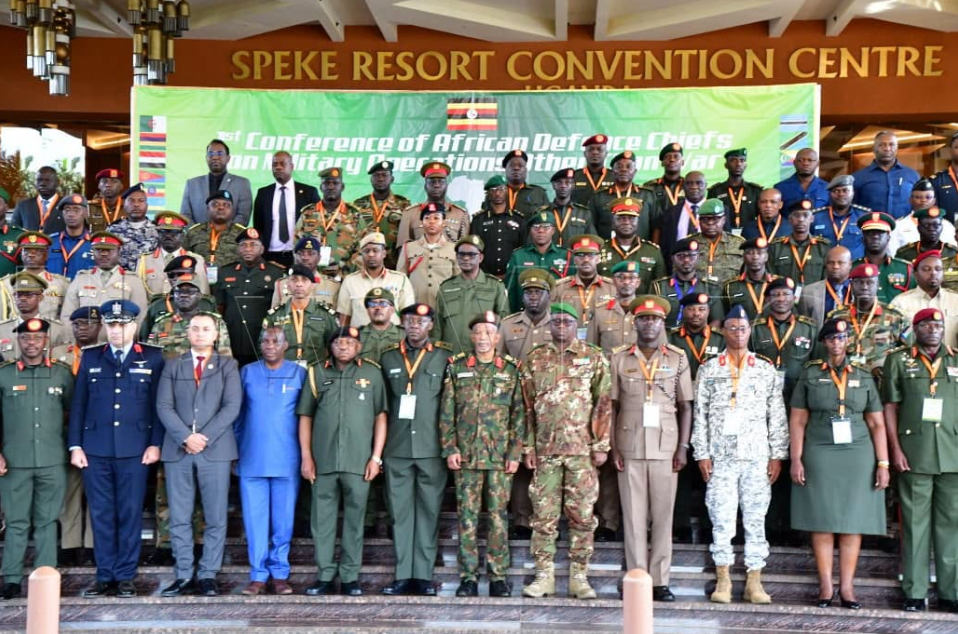
Uganda has hosted the first African Chiefs of Defence Forces Conference on Military Operations Other Than War (MOOTW), bringing together military and defence experts from across Africa to examine practical approaches to dealing with emerging and non-traditional security threats.
The four-day meeting is taking place at Speke Resort Munyonyo and has drawn delegates from more than 18 countries, African Union regional bodies, as well as Force Commanders serving in United Nations and African Union peace support missions.
Speaking at the opening of the conference, Uganda Peoples’ Defence Forces (UPDF) Chief of Joint Staff, Lieutenant General Jack Bakasumba, said Africa’s security environment has changed considerably, creating a need for militaries to adjust to a wider range of threats.
He identified terrorism, organised crime, cyber warfare, public health emergencies and climate-related crises among the challenges increasingly affecting the continent.
“Across Africa and the wider global arena, the security landscape has evolved away from interstate warfare, shifting instead toward a challenging matrix of interstate conflict and complex non-traditional threats,” Lt Gen Bakasumba said.
He said military personnel are increasingly operating in environments affected by limitations such as insufficient training, specialised equipment, effective early-warning systems and clear standard operating procedures.
“It was in response to this emerging security reality that this conference on Military Operations Other Than War was planned,” he said.
According to Lt Gen Bakasumba, the conference is intended to go beyond discussions of well-known security challenges and instead develop practical and coordinated systems that can be used to respond to emerging threats.
“It is our regional cooperation that must be enhanced. It is our standard operating procedures that require standardisation. It is our training and equipment procurement that should be streamlined,” he said.
He further called for improved information-sharing arrangements, joint communication systems and rapidly deployable capabilities to help African countries respond more effectively when crises occur.
“We must establish mechanisms that extend beyond discussions and conferences and can be translated into concrete standard operating procedures, training, early-warning systems, joint communications, information sharing and deployable capabilities,” he said.
The UPDF Chief of Joint Staff urged African nations to shift from policy discussions to practical investment in collective capabilities that can address emerging security challenges.
“We gather here today with a shared belief that Africa must strengthen its African-led, practical and coordinated responses to these emerging threats,” he said.
Lt Gen Bakasumba also highlighted the importance of Pan-African cooperation in maintaining security and commended President Yoweri Kaguta Museveni, regional leaders, defence chiefs, Regional Economic Communities and development partners for their contribution to peace and stability across the continent.
“It is this togetherness, driven by the spirit of Pan-Africanism, that has improved and sustained regional peace and security,” he said.
The inaugural conference is expected to contribute to stronger national and regional capacity to handle Military Operations Other Than War situations while promoting closer cooperation, partnerships and defence diplomacy among African countries.
It also offers defence leaders and military specialists an opportunity to exchange experiences and develop practical responses to security situations that fall outside traditional conventional warfare.